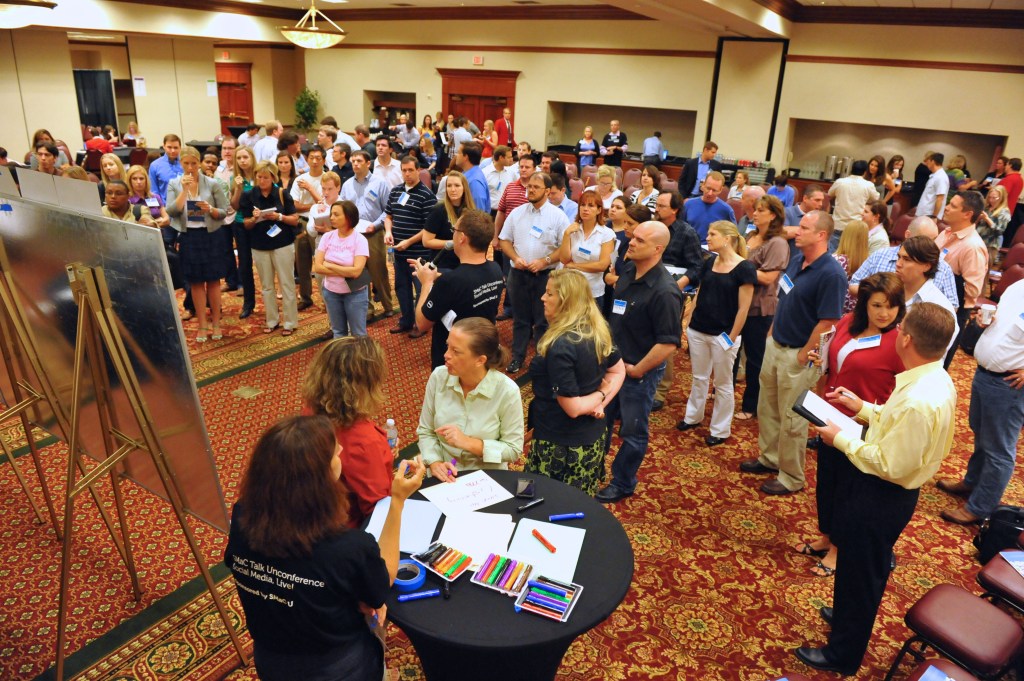
As we transition from virtual to in-person meetings, conferences, and workshops, there is a noticeable hunger for novel and engaging experiences beyond the typical “expert in front of the room” sessions. What if every event participant had the chance to be the smartest person in the room?
Rethinking Event Models
Imagine events, meetings, and working sessions that participants love, are intrinsically motivated to contribute to, and cover more ground topically than any singular organizer or facilitator could dream up. The key to achieving this is a shift from a host-centered to a participant-centered mindset. Fortunately, a set of methodologies and several communities of practice support this style of event.
Early Experiments: Online Community Roundtables
In the summer of 2005, I began hosting Online Community Roundtables in San Francisco, gathering many of the Bay Area’s community leaders for quarterly events. Local companies like Autodesk, SAP, and The WELL took turns hosting. These roundtables practiced a basic form of the participant-driven method: attendees set the agenda during the cocktail hour, leading discussions on the topics on their minds. This format allowed us to address real-world problems, issues, and opportunities in real-time while fostering a strong sense of community among participants.
Enter: The Unconference
Two years later, I discovered the concept of an “Unconference” and the robust participant-driven methodology of Open Space Technology (or just “Open Space”). The inaugural Online Community Unconference was held in 2007 at the Computer History Museum in Mountain View, CA. Over 300 community professionals collaboratively developed an agenda of 40+ topics in the morning and participated in sessions throughout the day. This event kicked off an Unconference series that ran until 2013, building a vibrant community of practice among attendees.

The Corporate Setting: Dell’s Success with Unconferences
The participant-driven approach works exceptionally well in corporate settings. At Dell, we launched a series of Unconferences to complement our social media and community (SMaC) strategy rollout and training. These events were so popular that they were hosted worldwide—in Round Rock, London, Bangalore, and even Xiamen, China, with real-time English/Chinese translation. Dell executives supported these events, and Michael Dell himself closed out the first Unconference in Round Rock. These Unconferences not only advanced our strategic goals but also strengthened the internal community and collaboration within Dell.

Tapping into the 95%
What would happen if you hosted a conference on a topic people were passionate about but threw the agenda out the window? While you might miss out on the wisdom of keynote and featured speakers, consider this: keynote speakers typically represent less than 3-5% of the attendees. What if you tapped into the other 95% who never get to speak?
- Think about the collective knowledge and experience of the 95%.
- Think about all they have to say that often doesn’t get said.
- Think of all those ideas not expressed.
It seems like a waste, doesn’t it? Fortunately, there is an alternative.
Embracing Participant-Driven Methodologies
Unconference (Open Space) is one of several people-centered methodologies that craft the event experience around the participants. By leveraging these methodologies, we can create dynamic, engaging, and inclusive events that harness the collective intelligence of all attendees, leading to richer and more diverse discussions and outcomes. These methodologies not only enhance the event experience but also foster a stronger sense of community among participants, as everyone has a voice and contributes to the collective knowledge.
An Short Guide to Unconferences
As we look to the future of events, embracing participant-driven methodologies like Unconferences can transform the traditional event model. By tapping into the collective knowledge and experience of all participants, we can create events that are not only more engaging but also more impactful and meaningful. More importantly, these approaches build stronger, more connected communities, where every participant feels valued and heard, leading to lasting relationships and collaborative success. To learn more, be sure to check out the guide below.
Want to learn more about people-centered events?
Sign up for our announcements list to be notified of upcoming research and events.https://structure3c.typeform.com/events
Need help with your customer relationship strategy?
Reach out to explore@structure3c.com for an initial consultation.
 Bill Johnston
Leave a comment